
⛾ Seizing the means of EdTech
The creation of bespoke software has never been easier and has the ability to individualize our tools to best befit our systems, rather than our tools continuing to dominate us.
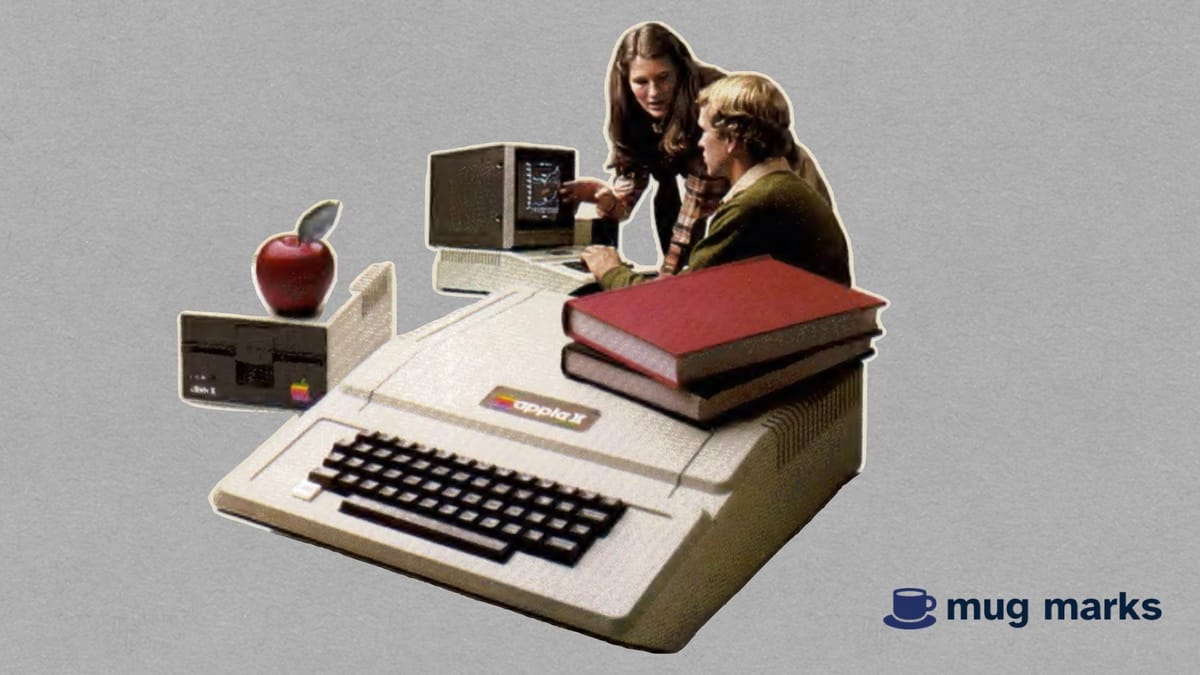
The year was 1982 and Apple was in dire straits. Their stock was in decline, still riding the high of the then 5-year-old Apple II's success and licking their wounds from the Apple III's concrete-denting thud upon reception. They were just on the horizon of a series of monumental failures as well as the infamous ouster of Steve Jobs as CEO. It was here that an oft overlooked deal in the world of education was struck.
A significantly underesourced and untapped market Apple recognized was schools. Steve Jobs later recalled in his 1995 interview with the Smithsonian[1] that "...one of the things that built Apple was schools buying Apple II's." Jobs was a strong proponent in bringing computers into schools remembering "We realized that a whole generation of kids was going to go through the school system before they even got their first computer so we thought the kids can’t wait."
His idea was simple: Apple can donate a computer to every school in America and they get a tax credit for their donation, taking a 10% loss on the product, but gaining a powerful hook into this market. By pure coincidence I'm sure, the unspoken benefit of this donation is that it would invariably lead to schools buying more computers and software from Apple, bolstering their coffers. After a year of personally lobbying Congress, shaking hands with the vast majority of the House, the federal bill died in a Senate lame duck period[2], and Jobs quickly grew impatient, losing interest soon thereafter.
Hope was not totally lost, though. The California State Government swooped in to create a similar program, and with reportedly little input from Jobs or Apple, The Computers in Schools tax credit (A.B. 3194) was born. So in 1983, Apple's new Kids Can't Wait program distributed over 9,000 Apple IIe's across Californian schools, along with some accompanying software, and free teacher training for this new technology.
Thus, the inseparable bond between tech companies and schools began – The rest is history.
As hardware and software continued to evolve – and technology became more ingrained in students learning and teacher workflow – so too did the business models, which shifted from ownership of materials to the licensing of them. Software as a Service (SaaS) has promulgated into each branch of our profession, stretching budgets thin, making faculty reliant, and leaving IT powerless. This is the effervescent you'll own nothing and be happy model that demands consumers pay a subscription to watch a movie, rather than just buy the Blu-ray. And it has been extraordinarily profitable for businesses, and deprives individuals of control over what they use and how they use it. Schools continue to license software and create dependence on systems that may not exist in the years to come, and with budgeting issues all across the country, it is more important now than ever to take inventory of the systems our schools choose.
In this way, my taking part in some agonizing meetings this year with textbooks sales representatives (whose branded merch and evasive answers were not taken kindly to) and the subsequent PLC's after choosing a vendor shine a bright spotlight on this new collective reality: With the deluge of technology that flooded the educational landscape, we are more beholden than ever to thorny software which shape our systems, rather than adaptable technologies that adjust to us.
For the last few months we have painstakingly attempted to get the textbook to communicate with Canvas and both to communicate with our gradebook. We have had to create hacky work-arounds and janky workflows so that this software fits into our lives, all for a service that we may not renew in 5 years time. With trivial results and hours wasted, it is apparent that this work has little to do with our ultimate goal: to help our kids learn best. EdTech here serves as an active detriment to what teachers should doing and how technology should be harnessed to empower us to teach and our students to learn.
In the programming world, they describe these companies as Merchants of Complexity. Renowned programmer David Heinemeier Hansson had this to say back in a 2024 blog post:
You see this syndrome all over the tech industry. Basic problems people could easily solve for themselves, cheaply and quickly, getting turned into scary and insurmountable challenges that only a sophisticated solution (usually on a subscription!) will cure.
Education is clearly one of the most lucrative sectors for tech companies to sink their teeth into. Like any government entity, and a company like Apple in 1982 reportedly sustained an entire quarter of their business on education sales alone. SaaS companies today have seeped in to the landscape with subscriptions galore to solve problems that they themselves created. But if Hansson is right that we have the power to solve it ourselves, then how?
Earlier in this chaotic semester I ran into an issue: I planned for a simulation in one of my history classes, but there was last-minute IEP meeting scheduled that pulled me out of class that period. Given the choice to either adapt the simulation or not doing it at all in my absence, I turned to Gemini. Within about a prep period of work, I was able to adapt the simulation so that it can be played with a partner, with instructions and rules, completely interactive, in a static HTML site that I hosted on GitHub Pages. When coming back the next day and following up on my day of absence, it was clear that the game actually connected with students, achieving some (though not all) of the outcomes I planned to address had I'd been in the classroom.
This led to my core revelation: If a tech-enthusiast educator like myself with microscopic coding knowledge can create a bespoke piece of software with AI, then what else can we build to ease our workflows and increase the capabilities of our educational systems without the need for these merchants of complexity? We are now living in an unprecedented time where teachers and schools can own the means of technology. The creation of bespoke software has never been easier and has the ability to individualize our tools to best befit our systems, rather than our tools continuing to dominate us. These would be tools that we completely own, which, if not replace our current technology, can ease the tension between our disparate systems.
As my colleagues and I sit around and banter about the shortcomings of our online gradebook, one of us jokes "I could create a better gradebook on Sheets!"
Honestly, we can and we should.
This interview was surprisingly filled with Jobs' takes on the education system. His pro-Voucher and anti-Union postitions were put on clear display. His thoughts on the inability for computers to replace teachers were quite prescient. ↩︎
In the words of our dear nameless Boy in the song I'm Just a Bill "By that time it's very unlikely that you'll become a law. It's not easy to become a law, is it?" ↩︎